The Walled City of Lahore has witnessed many notable eras
and empires which painted Lahore in their own ways. In the narrow meandering
streets of the old city you can still find remnants of the glorious past. It is
not arduous to visualize the bygone majesty by looking at the countless
striking structures that are still intact while some have crumbled to grime.
Among copious stunning monuments the gates of the walled
city cannot be overlooked. The Walled City of Lahore was known so because of a
9 meter high brick wall having a rampart running around it. The thirteen wooden
gates gave access to the city from all sides and were closed after sunset. The
purpose was to protect the city from the enemies’ assail. These gates along the
wall were constructed during Mughal Emperor Akbar’s era (1584 -1598). During
Ranjit Singh’s (the first Maharaja of the Sikh Empire 1799 to 1849) reign, the
fast falling walls were rebuilt which existed till the 19th century. The Gates
and Wall of the Walled City of Lahore were demolished during the British Raj.
The bricks of bulldozed gates and walls were used in the construction of the
Railway Station and other buildings by a contractor Mian Sultan. Only the Roshnai Gate near the Samadhi of
Maharaja Ranjeet Singh survived and still attains it originality. The additions
of circular garden and circular road were made instead of the wall by the
British. The historians claim that all the city gates were built on the pattern
of Roshnai Gate. Some of the gates were rebuilt but in simple structures. The
Delhi Gate and Lahori Gate, if taken a deep look, reflect the colonial
architecture. Only six of the thirteen ancient gates are intact till today. It
is said by the historians that some gates fell apart during the war of
independence and were never reconstructed. The gates we see today are Delhi,
Sheranwala, Bhatti, Kashmiri, Lohari and Roshnai, rest are a chapter of history
now. I wish I could see the real stateliness of the city enclosed in a wall,
just envision the life and defense measures in those times.
Kashmiri Gate falls between the Sheranwala and Masti Gates
on the circular road and is adjacent to Delhi Gate. The Kashmiri Gate is named so
because it faces the direction of Kashmir. During Mughal rule Kashmir had an
immense importance and so did this gate. It is one of the gates which were
reconstructed by the British in a much simpler form and has a similar
architectural character as the Bhatti Gate. A lofty pointed archway is flanked
by solid portions on either side which are divided into panels in the Mughal
manner. Although constructed with brick masonry, it has been painted. A steep
path constructed with Nanak Shahi bricks leads to the main road and is known as
Kashmiri Ghatti (slope). There are remains of the old wall reconstructed in
Ranjit Singh’s times accompanied by some worn-out buildings. The decrepit doors
and balconies of these buildings still exist as a proof of past glory and
transformations. It is a widespread bazaar with narrow markets and alleyways in
every corner.

 Like other gates, the interior of this gate has many shops
which are mostly the encroachments. This is one of the main issues of
deterioration of monuments inside the Walled City. Most of the Gates and
monuments are encroached upon by several encroachments. As we traverse through
the gates of the Walled City we start noticing the temporary stalls and vendors
occupying the place. In this gate as well, there are tea, lassi, fruit and
juice stalls.
Like other gates, the interior of this gate has many shops
which are mostly the encroachments. This is one of the main issues of
deterioration of monuments inside the Walled City. Most of the Gates and
monuments are encroached upon by several encroachments. As we traverse through
the gates of the Walled City we start noticing the temporary stalls and vendors
occupying the place. In this gate as well, there are tea, lassi, fruit and
juice stalls.
There is a girl’s
school established in an old haveli. Nobody has any information about this
haveli but in some history books it is mentioned as “Haveli Rani Gul Begum’. This
Haveli was named after one of the wives of Maharaja Ranjit Singh who lived in
this place after her marriage with Maharaja. The Maharaja at the age of 51
married this girl who was a courtesan and brought her to Lahore from Amritsar.
At that time he bought her this Haveli inside Kashmiri Gate.
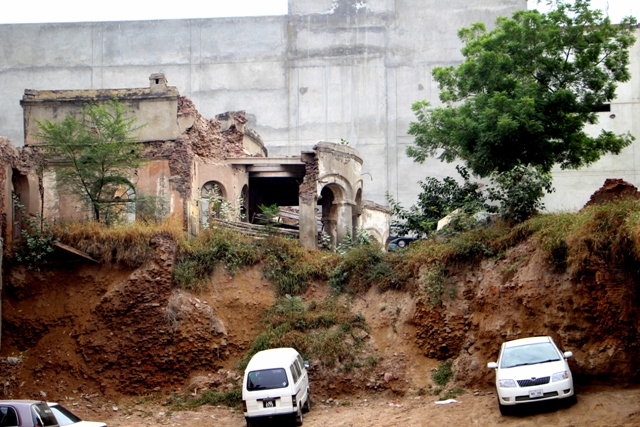
 Another interesting fact about Kashmiri Gate is that it is
located on the highest point indie The Walled City. The city was constructed
over a mound and archival pictures and paintings show the gate as the highest
point of the city. At the same point comes another marvel of the old times,
near Kashmiri Ghatti, the Bangla of Ayub Shah. It was built in Sikh period. In
1849, and was taken over by an Afghan chieftain Ayub Shah. Bangla Ayub Shah was
important as the “secret escape tunnels” emerged from there and headed towards
River Ravi as it flowed near the gate. At present the only thing we see is a
roman style veranda on the front side rest of the building has collided with
the passage of time.
Another interesting fact about Kashmiri Gate is that it is
located on the highest point indie The Walled City. The city was constructed
over a mound and archival pictures and paintings show the gate as the highest
point of the city. At the same point comes another marvel of the old times,
near Kashmiri Ghatti, the Bangla of Ayub Shah. It was built in Sikh period. In
1849, and was taken over by an Afghan chieftain Ayub Shah. Bangla Ayub Shah was
important as the “secret escape tunnels” emerged from there and headed towards
River Ravi as it flowed near the gate. At present the only thing we see is a
roman style veranda on the front side rest of the building has collided with
the passage of time.
The area inside the Kashmiri gate is much commercialized
than residential. The interesting streets are Takia Kabootar Shah, Katri Bawa and
the Kashmiri Block. As we pass through the Kashmiri Block we can approach the Chunna
Mandi College and the Janam Asthan of Guru Arjun Raam Daas who was the fourth
of the Ten Gurus of Sikhism and was born in Chunna Mandi in 1534. On
the other side, the road leads to the Chowk Purani Kotwali where Wazir Khan
Mosque is located. The gate also leads towards Asia’s biggest cloth market,
Azam Cloth market. This is an interesting and a colorful sight.

The passage is being used by tourists but unfortunately is
not very popular in terms of a tourist trail. There is a lot of history to be
shown in this route. The entire walled city is a labyrinth and any turning from
any gate can lead you to a new location. It is better to have a tourist guide
along if you are new to the place, but it’s a must visit site!
(The writer is a
media professional and can be contacted at taniaq29@gmail.com)